The EU issued the new Measuring Instruments Directive (MID) 2014/32/EU in 2014, which took effect in April 2016 and replaced the original Directive 2004/22/EC. MID is an EU regulation for the supervision and administration of measuring instruments, specifying technical requirements and conformity assessment procedures. The directive aims to establish a single market for measuring instruments. Manufacturers obtaining one certificate can freely sell products across the entire EU market.
MID Measuring Instruments Certification Service
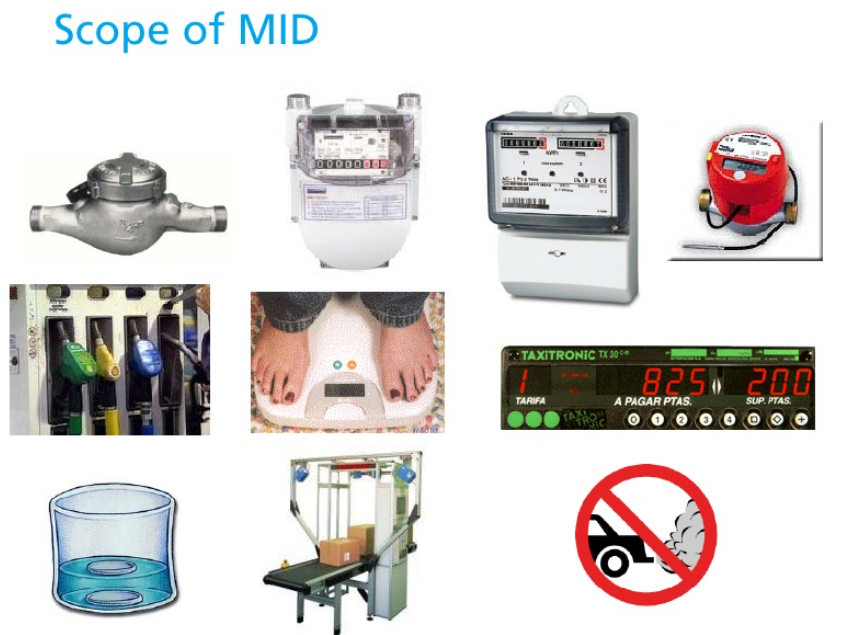
Scope, Modules and Harmonized Standards of MID Certification
The MID directive defines general requirements and conformity assessment procedures for all measuring instruments, and sets special requirements for ten categories of instruments (Annex MI-001 to MI-010):
|
No. |
Measuring Instrument |
CE Module |
MID Annex |
Harmonized Standard |
|---|---|---|---|---|
|
1 |
Water Meter |
B+F, B+D, H1 |
MI-001 |
EN14154 |
|
2 |
Gas Meter |
B+F, B+D, H1 |
MI-002 |
EN1359, EN 12261, EN12405 |
|
3 |
Electricity Meter |
B+F, B+D, H1 |
MI-003 |
EN 50470, EN 62058 |
|
4 |
Heat Meter |
B+F, B+D, H1 |
MI-004 |
EN1434 |
|
5 |
Liquid Meter |
B+F, B+D, H1 |
MI-005 |
|
|
6 |
Automatic Weighing Equipment |
B+F, B+D, H1 |
MI-006 |
|
|
7 |
Taximeter |
B+F, B+D, H1 |
MI-007 |
|
|
8 |
Material Measuring Instrument |
A1, F1, D1, E1, B+E, B+D, H |
MI-008 |
|
|
9 |
Dimensional Measuring Instrument |
B+F, B+D, H1, G |
MI-009 |
|
|
10 |
Exhaust Gas Analyzer |
B+F, B+D, H1 |
MI-010 |
Note: The MID directive does not cover non-automatic weighing instruments, which remain regulated by the unchanged NAWI directive. Products without specific harmonized standards shall complete CE certification in accordance with directive requirements.
MID Certification Modules
Generally, all New Approach Directives are based on a unified conformity assessment system detailed in Council Directive 93/465/EEC of 22 July 1993, which also specifies CE marking modules and usage rules. All New Approach Directives adopt this framework, while MID has made necessary adjustments for legal metrology management.
CE modules provide manufacturers with multiple compliance routes for MID, covering design and production control of measuring instruments.
MID specifies tailored conformity assessment procedures for different instrument types in relevant annexes. For example, gas meters specified in MI-002 allow manufacturers to select B+F, B+D or H1 procedures.
-
Module A Declaration of Conformity based on internal production control
(A1 = A + product testing by notified body)
-
Module B Type examination by notified body
-
Module C Type Declaration of Conformity based on internal production control
(C1 = C + product testing by notified body)
-
Module D Type Declaration of Conformity based on quality assurance of production process
(D1 = Declaration of Conformity based on production process)
-
Module E Type Declaration of Conformity based on quality assurance for final product inspection and testing
(E1 = Declaration of Conformity based on final product inspection and quality assurance)
-
Module F Type Declaration of Conformity based on product certification by notified body
(F1 = Type Declaration of Conformity based on product verification by notified body)
-
Module G Declaration of Conformity based on unit verification by notified body
-
Module H Declaration of Conformity based on full quality assurance system
(H1 = H + product testing by notified body)
Terminology: DoC: Declaration of Conformity QA: Quality Assurance
All modules are fully described in the MID directive. Letters A–H represent basic module types, while suffix number 1 (A1, C1…H1) indicates minor supplementary requirements. They are consistent in principle with slight differences.
NAWI Non-automatic Weighing Instrument Certification
The EU issued the new NAWI Directive 2014/31/EU in 2014, enforced from April 2016 to replace Directive 2009/23/EC. Non-automatic weighing instruments must obtain NAWI certification before entering the EU market. A non-automatic weighing instrument refers to weighing equipment requiring manual operation during weighing.
OIML International Metrology Certification
For weighing instruments, OIML certification is widely adopted internationally. OIML is an international metrology organization with 60 full members and 49 correspondent members, covering most developed economies. OIML certification is granted to instruments complying with OIML international recommendations, helping enterprises enhance product competitiveness.
How to Comply with MID
Manufacturers are obligated to ensure measuring instruments placed on the market comply with MID and take full responsibility for product design and production. Manufacturers shall fully understand product design and structure to meet regulatory requirements.
Subcontracting of design and production is permitted for qualified manufacturers capable of fulfilling MID obligations.
Manufacturers must issue a Declaration of Conformity, an official document certifying compliance of instrument types with the MID directive. A copy of the DoC shall be attached to every product sold. The original document shall be kept on file by the notified body for 10 years, applicable to both EU and non-EU manufacturers.
Manufacturers may select authorized notified bodies and choose applicable certification modules under professional guidance. Notified bodies are responsible for type approval, design assessment, product testing and quality system certification.
As MID does not mandate fixed test procedures, multiple approaches are available for type approval (Module B). Manufacturers may achieve MID compliance through the following three methods:
-
01
Adopt EU harmonized standards published in the Official Journal and declare compliance accordingly.
-
02
Refer to OIML standard documents; OIML recommendations serve as key references for product assessment.
-
03
Where no harmonized or standard documents exist, notified bodies shall verify product compliance with MID requirements. This flexible approach suits innovative products via customized test programs.
After full compliance with relevant directives, manufacturers may affix the CE mark and supplementary metrology marking on products.


 Get More Information
